An ADHD planner that works with a busy mind, not against it.
If keeping the day in your head doesn’t work — and streak apps punish you for being human — this ADHD planner was built around a different set of choices. Here’s what they are and the research behind them.
This page is wearing Sage: softer greens, quieter contrast, easier on a busy mind. One of six themes, all free.
The pain
You know exactly what needs doing. The day still happens to you.
The list exists — mostly in your head, which means holding it costs effort all day long. Starting is a wall. Twenty items scream equally. And the app you tried last time reset your streak the first day you missed, which told you everything about who it was built for.
“I knew what to do. Starting it was the wall.”
“I’d pick the app up, tidy it for twenty minutes, and do none of the work.”
“Every system I tried needed more setting up than the job did.”
“One missed day and I’d quietly stop opening it.”
The answer
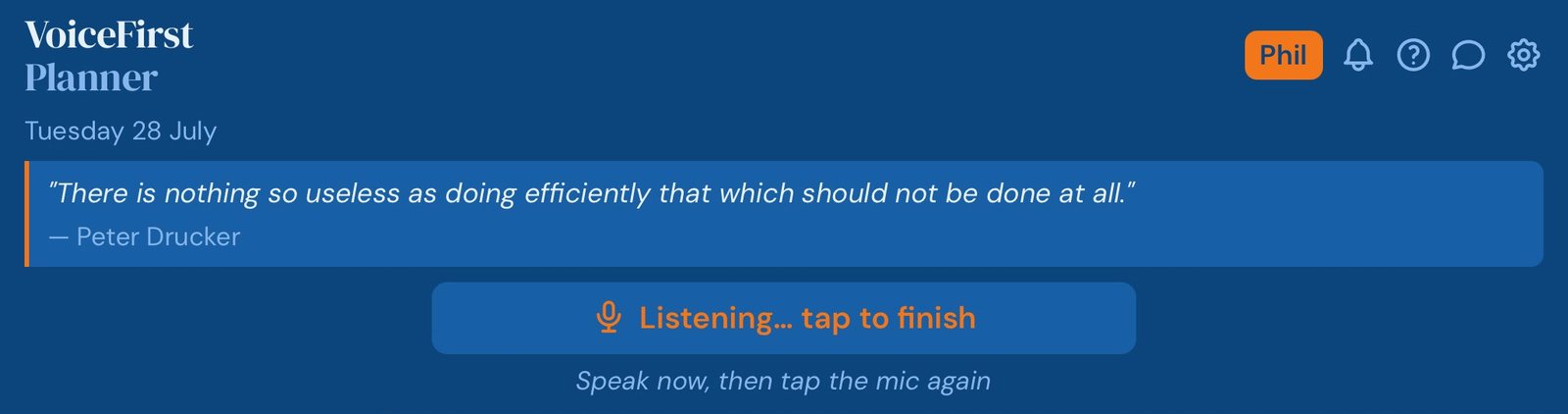
Out of your head, out loud, at the moment it occurs to you.
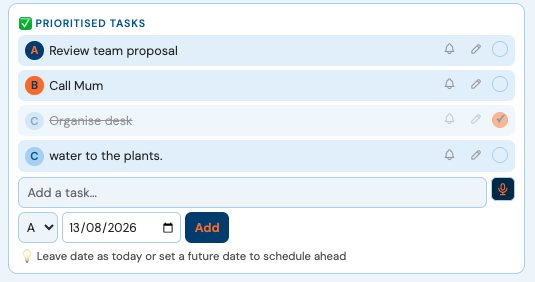
Speaking removes most of the capture tax. One tap and the thought is filed — no typing, no menus, no choosing where it goes. The distance between having a thought and having it written down is a sentence. Then three bands do the sorting twenty items can’t do themselves: A is must, B is should, C is nice. Two decisions run the day instead of twenty.
“Add call the accountant as an A priority”
Filed at the top before the thought could leave.
“My focus today is the quote”
One thing, pinned, visible every time you look.
What the research found
Across 94 studies, deciding in advance when and where you’ll act had a medium-to-large effect on whether people followed through.
That’s the mechanism this whole planner is built on — and the same research group later tested it specifically with children with ADHD, where the if-then plan lifted response inhibition to the level of children without ADHD. The mechanism appears to work hardest for exactly the people planning tools usually fail.
Habits grew from repetition in a consistent context — and missing a single day did not materially affect the process.
Which is why a missed day costs nothing you have already done. The days you did stay counted, and your best run stays in view. Miss a day; pick it up tomorrow. That is the entire recovery procedure.
What makes a good ADHD planner: four choices, made on purpose
A good ADHD planner asks for less, not more. Capture has to be instant, because a thought that waits for a keyboard is often gone. The list has to sort itself into a few priorities, not twenty equal ones. Time has to be visible. And a missed day cannot be a verdict. Those four choices are the whole design of this planner for adults with busy minds:
Nothing has to live in your head.Say it and it’s captured, dated, filed — so remembering it is no longer a job.
Time is visible.The schedule, the carried-days badge, the week and month at a glance — the future gets a shape instead of arriving as a surprise.
Capture happens at the moment, not at the desk.The point where a thought occurs is the point it can be filed.
No punishment mechanics.Tasks carry forward without shame. A missed habit day never wipes the days you did. The planner’s job is tomorrow, not a verdict on yesterday.
Work’s calendar can come in too — but through a door you control. Every meeting shown, every one tick or untick, nothing enters without you. For a mind that’s already carrying enough, the difference between a calendar that dictates and a calendar that asks is the whole difference.
The case for paper is real: it’s fast at the moment of capture and it never fights you. The friction was always the pen — everything written twice, everything unfinished copied forward by hand.
This planner is the paper layout with the pen removed. Planner view is the two-page spread itself, on iPad and desktop, filling itself in when you speak — and the phone carries the same day when you’re away from it. Faster than paper at the moment of capture, and nothing ever copied forward by hand again.
A digital ADHD planner, in other words, that behaves like paper at the moment of capture.
I’ve watched good, capable people give up on planning because the system punished them for one bad week. The system was the problem. It usually is.
— Dave Rees, Founder. From boatbuilder, to business owner, to Founder.
How it works
How to plan your day with ADHD: start with two things, not a system.
Say tomorrow’s one focus tonight.A single decided thing beats a reorganised everything.
Speak tasks the moment they occur.The capture is the habit; the sorting is the planner’s job.
Let the rest carry.Anything unfinished rolls forward on its own. Nothing to rewrite, nothing to feel bad about.
The one that asks the least at the moment a thought arrives: instant capture, a short prioritized list, visible time, and no punishment for a missed day. VoiceFirstPlanner is built around all four.
Is there an ADHD planner app for adults?
Yes. VoiceFirstPlanner works as an ADHD planner for adults — a daily planner app built around choices that suit busy adult minds: capture by voice, three priority bands, and tasks that carry forward on their own.
Is there a free ADHD planner?
VoiceFirstPlanner is free to start, with no card and no clock — a free daily planner for ADHD from the first day.
Paper or digital ADHD planner?
Paper is fast at capture and never fights you; the cost is copying everything forward by hand. A planner that captures by voice keeps the speed and drops the copying.
A planner that expects you to be human. Finally.
Free account. No card, no clock. It is the same daily planner everyone uses — built from the start around these four choices.