A habit tracker app that keeps your best run in view.
Goals get you started; habits keep you going. VoiceFirstPlanner’s habit tracker turns small daily actions into the person you want to be — ticked off by voice.
You miss one day and the whole thing quietly falls over.
Not because one day matters. Because the number went back to zero, and the app made sure you saw it. Thirty-one days of showing up, gone on a screen, over a late meeting and a flat tire. And the honest reaction to that is not “try harder.” It is “why am I doing this.”
“I missed a Tuesday and never went back.”
“Twelve days in a row, one bad week, and the whole thing was over.”
“The app that was meant to help me was the thing that told me I’d failed.”
“I’ve started the same habit four times and it’s the same February every year.”
What is a habit tracker?
A habit tracker is a simple record of the days you did the thing. Ticking the day is the whole mechanism: seeing the days add up is what keeps a habit going once the first burst of motivation has gone.
On paper it is a grid. In a habit tracker app it fills in as you go — a daily habit tracker and a weekly habit tracker at once.
The answer
Say you did it. That’s the whole interaction.
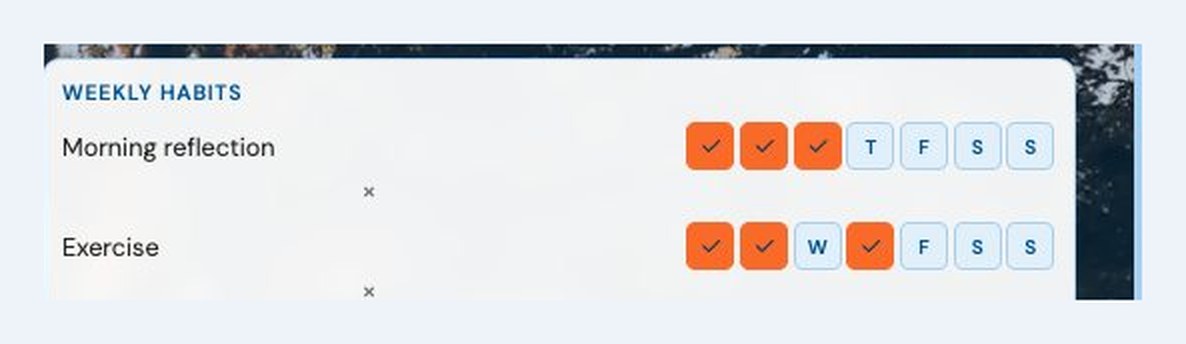
Speak it in the past tense as you go about your day — I exercised today, walked, ran — and today fills in. A seven-day grid shows the week at a glance and the count is there if you want it.
What you will not find: a streak that breaks on the first missed day, or a best run that disappears when it does. Pick it up tomorrow. That is the whole recovery procedure.
“I exercised today”
Today’s marked on the exercise habit. Nothing else needed.
Life Planning › Habits › tap the day
Same result, if your hands are free and your voice isn’t.
Four habits on the free plan, unlimited on Premium.
How long does it take to form a habit?
Not twenty-one days — that number is not in the research. Here is what one study that followed people through their ordinary lives actually found:
What the research found
Habits grew from repeating a behavior in a consistent daily context — and missing a single day did not materially affect the process.
Ninety-six people, twelve weeks, tracked in their ordinary lives rather than a laboratory. How long it took varied enormously — from 18 days to 254. The popular “twenty-one days” is not in the research. The honest finding is the range, and that one missed day did not undo it.
How many days it takes depends on the person and the habit. What matters is showing up more days than not, in the same context.
The design choice
A strict streak measures the wrong thing, and then punishes you for it.
A streak counts consecutive days. What actually builds a habit is showing up more days than not, in the same context, for long enough. Those are different things, and only one of them is undone by a flat tire.
So the grid shows you the week, gaps and all, and keeps going. One missed day is forgiven, and your best run is never erased.
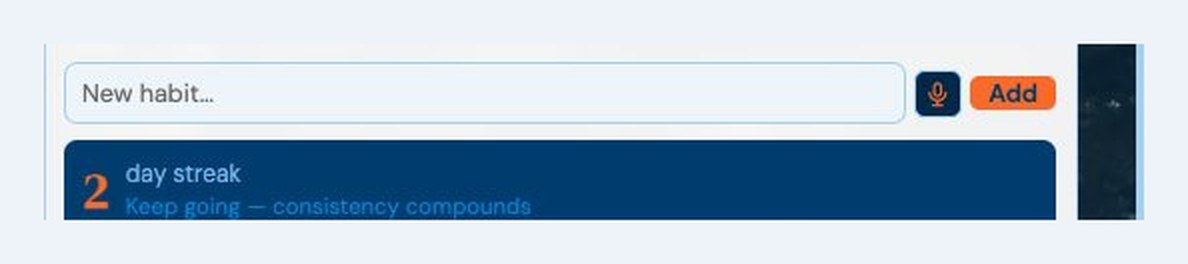
The streak counts the days you ticked any habit. Miss one day and it carries on. Miss a second and it starts again — but the best run you ever reached stays on screen, so a reset never wipes out what you did.
I have started more things on a Monday than I can count, and quit most of them on a Thursday. Never because the thing was wrong — because I missed a day and the missing became the story.
A planner that shrugs at a missed day is worth more than one that keeps score.
— Dave Rees, Founder. From boatbuilder, to business owner, to Founder.
Habit tracker ideas: what to track
Four is plenty to start. A few that work well:
Move for twenty minutes
Drink a glass of water before coffee
Read ten pages
Lights out by a set time
Walk after dinner
Stretch for five minutes
Write one line in a journal
No phone for the first hour
Call someone you care about
Tidy one thing before bed
How it works
How to form a habit: setting one up takes about thirty seconds.
Pick a few, not a program.Four is plenty to start. A habit you will actually do beats a list you admire.
Tie it to a moment you already have.After breakfast. Before the site. The context does the remembering for you.
Say it in the past tense.I exercised today. That is the entire daily interaction.
One that makes ticking the day effortless, shows the week at a glance, and forgives a missed day. VoiceFirstPlanner is a planner with a habit tracker built in, so the day and the habits sit together — and it does all three, by voice.
Is there a free habit tracker app?
VoiceFirstPlanner is free to start, with no card: four habits on the free plan, unlimited on Premium.
How long does it take to form a habit?
It varies widely — in one study, from 18 days to 254. The 21-day figure is not in the research.
Does missing a day break a habit?
In the research, missing a single day did not materially affect it. In VoiceFirstPlanner, one missed day is forgiven and your best run is never erased.
Show up more days than not. That’s all it takes.
Free account. No card, no clock. Your habit tracker sits in Life Planning, in the same app as your daily planner.